Accelerating your transition. To the right outcome.
Our approach is based on four essential elements – Strategy, Transformation, Management, and Optimisation.
Combining these elements into an integrated approach we identify and remove the obstacles to a successful outcome, before you even know they are there.
Get the services you need with the innovation to grow. Partner with Tecala for specialist IT services.
We provide consulting, project management, integration, management expertise and a flexible engagement model. Through our services you can focus on your ICT strategic initiatives, whilst reducing your operating costs.
Discover how we’ve worked with pioneers, market leaders, and innovators who want to use technology to challenge convention, make an impact, or leave a legacy.
Our client engagement model, along with our unique process and methodology, allows us to get closer to you, your team and the entirety of your operations. This approach enables us to get a better understanding of your business and technology challenges. And ensures our clients enjoy great outcomes from their technology initiatives and investments.
AI tools alone do not create adoption. Practical training helps people turn access into everyday capability.
Ian Gard7 min read
AI training for business
At a glance
Three things to know
Giving employees AI tools is not the same as helping them use AI confidently and responsibly.
Training works best when it focuses on real tasks and becomes a repeatable habit.
Measure practical adoption over time, not just attendance at a training session.
You can give two businesses exactly the same AI tools and get two completely different results.
In one, a handful of people become good at using it. They find their own shortcuts, work it into their day and start moving faster. Everyone else barely touches it. In the other, people across the business understand where AI can help, where it can’t, what they’re allowed to do with it and how to use it well, and they start applying it to real work rather than treating it as an interesting piece of technology sitting off to the side.
The difference is whether the organisation helped people turn AI into a habit.
That’s the job good AI training should do. Explaining what artificial intelligence is matters far less than helping people work out what to do with it on Monday morning.
Access to AI isn’t the same as AI adoption
This is one of the most common problems I see. An organisation buys the licences or approves a platform and assumes adoption will follow. But access on its own doesn’t give anyone the confidence or judgement to know where a tool fits their work, so people tend to land in fairly different places:
01Confident users already experimenting and working out what AI can do, sometimes finding useful things nobody else in the business knows about
02Interested but cautious people who’ve tried a tool once or twice, without much sense of what to ask it or whether to trust what it gives back
03People who avoid it altogether
04People using public AI tools for work without thinking much about what information they’re feeding in
That spread is what you’d expect when people are handed a new capability with no shared way of using it. Training is what starts to close that gap.
Habit is the real advantage
There’s a natural pull to treat AI adoption as a technology decision: which platform, which licence, Copilot or Claude or something else. Those decisions matter, but I don’t think they’re usually the hardest part.
The harder question is whether people actually use the technology well enough, and often enough, for it to make a real difference. A new platform tends to create a burst of interest: people turn up to a launch, try a few prompts, poke around for a week. Then normal work takes back over, and the tool becomes something a few people use and everyone else forgets about.
From training to practical results
Hands-on training on a real task is what breaks that pattern. In one session, a participant who’d never used AI brought along a job she’d budgeted about a month for. She left with a first draft and roughly five hours of work remaining.
That’s why I think the businesses that get the most out of AI will be the ones that make it useful enough, often enough, that it becomes part of how the work gets done, whichever platform they’re on. Done properly, training gives people the confidence to experiment, the judgement to know when AI is the right tool for the job and the practical skill to get something useful back from it. At that point the whole organisation can rely on AI, rather than a handful of people with their own habits.
What should good AI training actually change?
The test I use is whether people work differently after a session. Leaving with ten more facts about AI doesn’t count.
01
People can see where AI is useful in their own job, because they’ve learned it against work they recognise. Generic examples that look nothing like someone’s real job are one of the quickest ways to make AI feel irrelevant. The examples need to come from the work itself, whether that’s summarising a pile of information before a meeting, drafting a first pass they can improve, comparing documents, working through an approach to a problem, or cutting a repetitive step out of a process they do every week. A finance team, an executive assistant, a salesperson and an IT engineer shouldn’t walk out with the same use cases. Once people see their own work in the examples, the rest gets much easier.
02
People know where the boundaries are, which includes knowing when not to use AI: which tools are approved for work, what information can go into them, when an answer needs checking, and what still needs a human call. Without that clarity you tend to get one of two outcomes. People avoid AI because they’re worried about getting it wrong, or they use it without understanding the risk. Neither helps adoption.
03
People get better at working with AI, which takes real skill: explaining what you’re trying to achieve, giving the right context, and improving a result instead of accepting the first answer. It clicks far faster when people practise on something real than when they watch a slide about good prompting, which is why I’m a strong believer in keeping this hands-on.
04
The organisation starts finding its own opportunities, because training also tells you where AI has value in your business. Once a team understands what AI can realistically do, the conversation changes from a broad “what should we be doing with AI?” into something much more specific, like “we spend hours on this every week, could AI help?” or “could Copilot get us through this process faster?” Those are far more useful conversations, and they come out of the work people are already doing rather than a strategy invented in a meeting room.
AI training shouldn’t be one-size-fits-all
Another mistake is treating AI training as a single course everybody sits through. Different parts of the business need different things, so it helps to think about a few distinct starting points rather than one program:
01AI Navigator Briefing, for leadership teams still working out where AI fits and what to focus on first, before any platform or budget is locked in
02AI 101 Training, the practical foundation for the whole team: what these tools are good at, where they go wrong, and how to use them without putting company data at risk
03Claude Immersion Workshop or Microsoft Copilot Immersion Workshop, once you’ve settled on a platform, built around your team’s real work rather than a demo, with a Copilot Studio Immersion Workshop for teams ready to build agents and an MCP Immersion Workshop for connecting AI securely to your own systems
04Claude Kick Starter or Microsoft 365 Copilot Kick Starter, pairing a readiness check with a guided pilot on a real piece of work, for teams ready to properly commit to a platform
There’s no benefit jumping straight to platform-specific training if half the business is still unsure what they’re even allowed to use AI for. Start where your people are, and save the most advanced option on the list until they’re ready for it.
How do you know whether AI training worked?
I wouldn’t start with attendance. You can have every seat filled and change nothing. A better set of questions is what happens afterwards:
✓Do people feel comfortable using the approved tools?
✓Are they using AI for real work, rather than occasionally opening it to experiment?
✓Can they explain what information they should and shouldn’t share?
✓Are useful applications starting to show up across different teams?
↗Most importantly, are people still using it in three months?
If everyone enjoyed the session but nobody’s using AI a few months later, the organisation hasn’t built capability. It ran an event.
Where should you start?
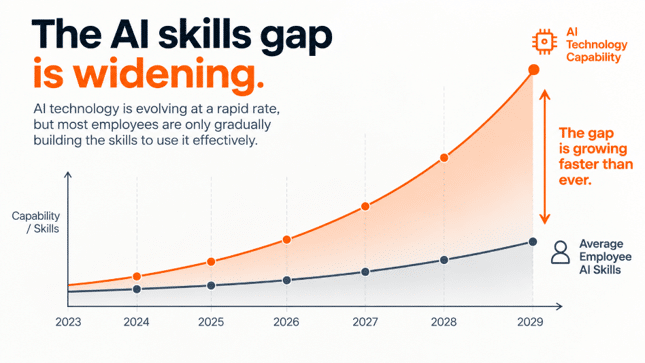
The best time to start is now, because the gap between what AI tools can do and what your team knows how to do with them doesn’t stay still. Every release makes the tools more capable, and every month without training leaves your team a bit further behind.
Where you start depends on where your people are. If they’re experimenting without guidance, a common foundation in responsible use is probably the priority. If they have licences but adoption is low, hands-on training built around real work will do more than another overview session. If a team is ready to go deeper on a specific platform, that’s when immersion training earns its place. And if leadership is still deciding where AI fits at all, start there, before buying more technology.
At Tecala, we offer the most up-to-date AI training workshops and solutions for your organisation. If you’re trying to work out where your organisation should start, book a free AI Navigation Call on the form and we’ll talk through where your team is today and the most practical next step.
FAQ
Frequently asked questions
Why is AI training important for employees?
Access to AI tools does not automatically mean people know how to use them well. Practical training helps employees identify relevant tasks, understand boundaries and build the confidence to use approved tools in their daily work.
What should workplace AI training cover?
It should cover real tasks from participants’ roles, appropriate and inappropriate uses of AI, company information-sharing rules and practical skills for improving AI-generated results.
How can a business tell whether AI training is working?
Look beyond attendance. Check whether employees use approved tools for real work, understand information-sharing boundaries, identify useful applications and continue using AI in the months after training.
About the author
Ian Gard
Ian Gard is an AI Solutions Specialist at Tecala, helping organisations turn AI and automation into practical business outcomes. Winner of the 2025 ARN Innovation Award for Technical Excellence, he has helped develop Tecala’s AI Agent Dream Team and more than 40 applied AI use cases. His work focuses on making emerging technology useful and accessible in everyday business.

 Ian Gard