Writing about AI in Australia is becoming arguably more difficult than implementing it.
Market clichés are running wild and executive cynicism is trending high. Insights are surface-level, commentary is commoditised and guidance is generic.
Everyone is saying the same thing without saying anything.
Starting at a position of originality and authenticity has never been more critical in helping organisations truly understand, and crucially, unlock the benefits of becoming a Frontier Firm in Australia.
Hence Inside the Frontier Operating System, an Executive Roundtable created to outline the foundations that distinguish businesses experimenting with AI from those embedding it into the fabric of decision-making, operations and customer engagement.
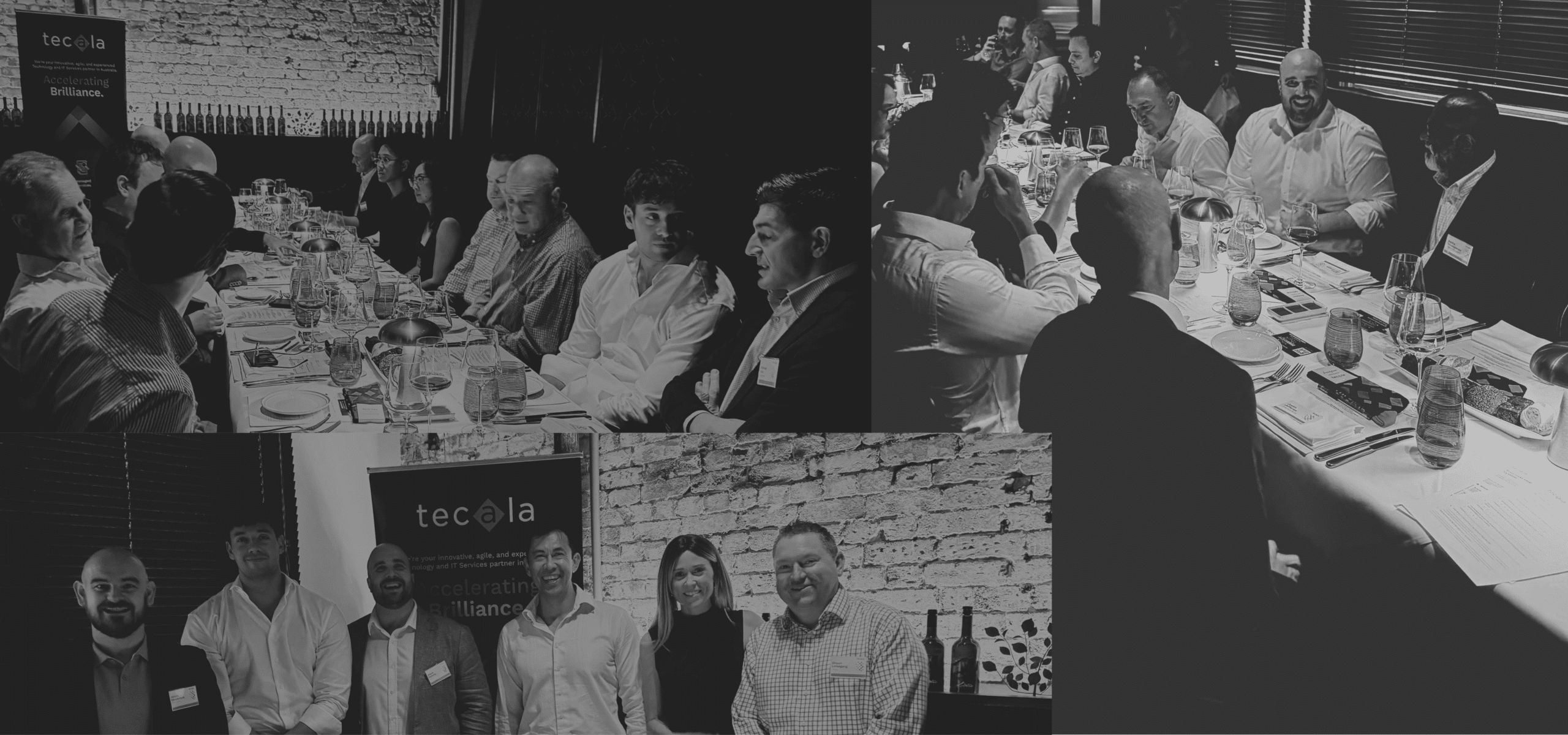
This exclusive session in Sydney housed CIOs, CTOs and Directors, forming part of an Executive Insights Program, The Frontier Firm: An Australian Approach, designed to explore what it takes to build and lead a Frontier Firm in Australia.
Through independent research, executive roundtables and industry analysis, this editorial series will outline how organisations are navigating this transition, the challenges they face and the opportunities ahead.
So, let’s start at the start.
“A Frontier Firm is the name for an organisation that is not dictated by how much money they make or how much their turnover is, it’s about mindset,” outlined Shaun Leisegang, Chief Automation, Data and AI Officer at Tecala Group.
In other words, this is not a numbers game.
Frontier maturity isn’t defined by organisational scale or technology spend, rather by the effective combination of humans, automation and AI in the pursuit of innovation.
“There’s three very critical pieces of the puzzle,” Leisegang continued.
“The good news is that humans are not going anywhere. We will be more important than ever and will take a lead role in passing judgement and making decisions, but our work will change.
“The second ingredient of this recipe is automation. How do I automate business processes? That might be for employee onboarding, accounts payable or customer support.
“The third ingredient is the newest entrant and that is an AI agent. A mix between GenAI and the ability to think on its own, combined with automation and the ability to go and action something.
“Frontier Firms combine all three, humans, automation and AI agents.”
Personal productivity opens the company door
The modern enterprise in Australia is now underpinned by two critical AI pillars, personal productivity and company-wide productivity.
From the tools that lift individual output to the pre-built agents and end-to-end apps that change how the work runs, forward-thinking organisations are operationalising AI in a secure, scalable and sustainable way.
Before businesses can redesign work at scale, however, employees must understand what AI makes possible.
Human experience is the differentiator
Leisegang describes this as personal productivity, one of two major components within Frontier Operating System.
“How can we make an individual more powerful with AI?” Leisegang asked.
“But more output does not necessarily equal better output. We’re seeing a lot of people think that because they have an AI tool, that’s a green light to put AI slop into the market. The problem is, people can now easily identify AI-generated content and more often than not, their minds switch off.”
Instead, the stronger opportunity is to combine AI with something less commoditised: human experience.
“The unlock is how you can actually use your intellectual property, the years of your experience, what you’ve done in your role, and supercharge yourself with AI,” Leisegang explained.
“That’s what we mean by personal productivity.”
The second component is company-wide productivity.
“That’s how to automate end-to-end business processes through the combination of humans, automations and AI agents,” Leisegang added.
Company-wide productivity is the bigger prize
Personal productivity remains an important foundation because it offers employees familiarity with AI and expands user understanding of what is possible.
But businesses must understand the difference between making an individual faster and changing the economics of an organisation.
The larger opportunity sits in company-wide productivity: breaking apart an entire workflow and deciding which activities belong with people, deterministic automation or AI agents. That is when AI moves from delivering individual to organisational impact.
AI licences don’t create capability
The conversation has shifted beyond pilots and proof-of-concepts towards building the organisational capabilities that enable AI to deliver measurable business outcomes.
But moving between personal productivity and company-wide productivity is where many organisations in Australia are encountering roadblocks.
“I think the golden rule is: if a business thinks they can just licence for Claude, ChatGPT or Microsoft 365 Copilot, and everyone’s going to get better, that’s not what we see,” Leisegang cautioned.
Yes, AI can be provisioned quickly. But true capability develops more organically and authentically.
“Businesses need to invest the time in workshops and in training,” Leisegang added. “Claude immersion workshops, Copilot immersion workshops, ChatGPT immersion workshops, just training, training, training.”
The alternative? Expecting employees to single-handedly navigate one of the largest changes in working practices in decades, alongside managing the day-to-day requirements of the actual role.
“People are people and most want to carry on doing things the way that they’ve always done it,” Leisegang acknowledged. “Some will independently experiment and rapidly build capability but the majority of people are just trying to get through their day.”
In response, Leisegang highlighted that structured training, individual coaching and peer learning are therefore part of the infrastructure required for effective AI adoption.
The habit that started an AI flywheel
For example, the team within Tecala deployed one simple mechanism at the start of each meeting: “How did I use AI this week?”
A subtle shift that starts to reshape company culture.
“The first week, no one chats, and it’s just me showing things,” Leisegang expanded. “Second week, maybe another person pops up and goes, ‘Oh, I did this thing.’ Week three and four, all of us, and that flywheel’s flying.
“That little show and tell proved absolutely key in getting that flywheel to start moving inside our own organisation.”
Personal productivity, in this sense, does more than save time. It expands the number of people inside an organisation capable of imagining how work could be done differently.
And that creates the conditions for the bigger change at a company-wide level.
Based on the discussion, it’s evident that technology capability is advancing faster than workforce capability.
Executives at the table repeatedly returned to training, coaching and change management as bigger constraints than access to technology. In short, generic AI education is viewed as insufficient.
One-on-one coaching for leadership teams
“We’re seeing huge traction in our Frontier AI coachin, one-on-one coaching with individuals that is proving to be extremely successful for organisations on this Frontier Firm journey,” Leisegang shared.
“They are tailored sessions which we’re running with boardrooms, executive leadership and senior leadership teams. Any leadership layer works to assess current work patterns and identify ways that AI can better support day-to-day activities.
“The first one to four sessions are providing most valuable because people then start to join that flywheel and the ideas start flowing.”
Consensus is building that AI adoption may require a more personalised approach than conventional training. For example, starting with an executive’s actual work creates relevance while removing the discomfort associated with publicly exposing capability gaps.
Stop adding AI to yesterday’s processes
Success in AI increasingly depends on far more than technology alone, it requires trusted data, modern cloud platforms, governance, cyber security, intelligent automation and leadership alignment working together as one integrated operating model.
The real unlock begins when organisations stop looking for places to attach AI to processes designed before the technology existed.
Consider a process such as accounts payable.
A traditional workflow may involve people monitoring an inbox, opening documents, extracting information, entering data into systems, routing requests for approval and dealing with exceptions.
The Frontier Operating System starts by questioning the process itself.
“To get to the good bits, businesses need to have a game changer,” Leisegang advised.
“If you’re just doing it for the sake of doing it and you’re not moving the needle, you might as well not do it. The game changer is actually taking a business process and deconstructing it.”
Once broken apart, each component can be reconsidered.
Deciding what’s human, automated or agent-led
“There could be a robot or an automation that looked at that email inbox 24/7, 365 and could extract the information from those documents,” Leisegang explained. “Sometimes it might need to reach out to a human to make a judgement and sometimes it might require an AI agent to make an interpretation based on the data and the context.”
That is the architectural decision at the heart of the model.
Because some work is predictable enough for traditional automation while some requires the reasoning and interpretation of an AI agent. Other moments require the experience, accountability or judgement of a person.
That is the Frontier Operating System in motion.
“A lot of businesses just think, ‘Oh, AI. Let me just tack it on here and tack it on there’ but the true unlock is in deconstructing the entire processes, there’s so many other ways to better solve these problems now,” Leisegang added.
“To reach the game changer level, businesses must look at that process, deconstruct it and then rethink it in a new world with the new tools available.”
Remember, human expertise becomes more valuable, not less
Rebuilding work around automation and agents inevitably raises the question of what remains for people.
Executives at the table strongly rejected the idea that a Frontier Firm means removing humans from every process. In fact, such an approach runs the risk of “cognitive surrender” which is notably damaging to junior professionals unable to make informed decisions based on a lack of experience and context.
“People will remain important, number one as the most important part of this loop,” Leisegang stated.
The nature of their contribution will change, however.
As machines absorb more execution, human value increasingly sits in experience, context, judgement and the ability to make decisions when there is no deterministic answer.
People who use AI will replace those who don’t
“Lots of people always say, ‘Oh, AI is going to take my job’ but actually, no, AI is not going to replace you,” Leisegang clarified.
“People who use AI might replace you, but people in certain positions will become even more critical. It’s how you supercharge your intellectual property, your know-how, your years of experience. Yes, you might supercharge yourself with AI, but there’s a fine balance between that, and you need to use it wisely.”
That places the human role at the centre of the Frontier Operating System rather than at its margins.
Because the ambition is not to blindly build an organisation with the most AI licences, the largest collection of agents or the highest number of automated processes. Personal productivity gives people the capability to work differently while company-wide productivity extends that thinking across the enterprise.
The defining question for an aspiring Frontier Firm is simple.
What would this organisation look like if it was designed again today, with people, automation and AI agents available from the start?
This exclusive session is part of an Executive Insights Program, The Frontier Firm: An Australian Approach, designed to explore what it takes to build and lead a Frontier Firm in Australia. Through independent research, executive roundtables and industry analysis, this editorial series will outline how organisations are navigating this transition, the challenges they face and the opportunities ahead.
Your Frontier Firm journeyExplore your next step with AI
Book a free AI Navigation call
FAQFrequently asked questions
What is a Frontier Firm?
A Frontier Firm combines people, automation and AI agents to rethink how work gets done. Its maturity depends on how effectively those capabilities support decisions, operations and customer engagement, rather than its size or technology spend.
How is personal productivity different from company-wide productivity?
Personal productivity helps individuals use AI to improve their own work. Company-wide productivity goes further by redesigning end-to-end workflows and deciding which tasks should be handled by people, automation or AI agents.
Why do AI licences alone not create capability?
Access to a tool does not automatically change working habits. Training, individual coaching and peer learning help people understand what AI can do, apply it to relevant tasks and retain the judgement needed to assess its output.

 James Henderson