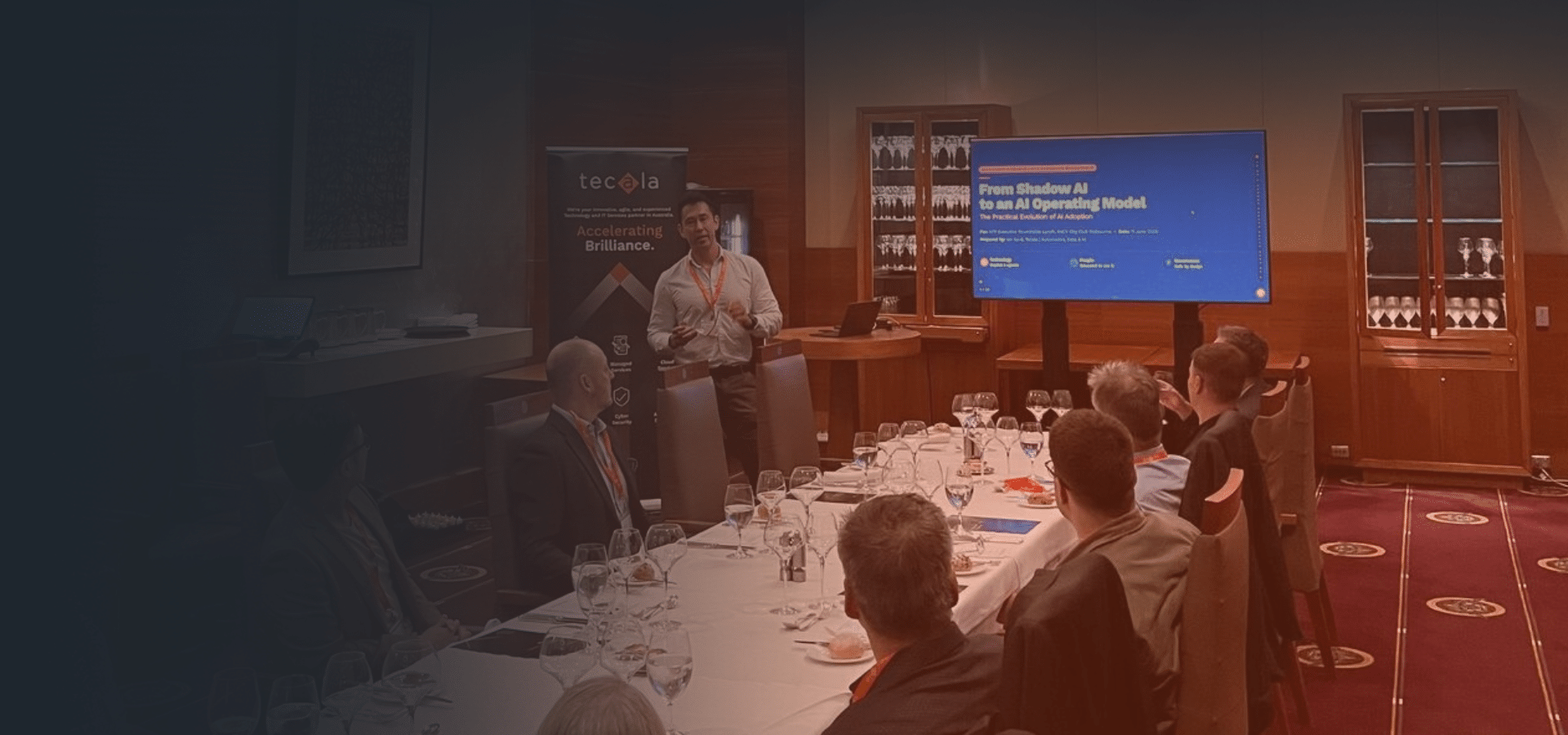
AI is already being used inside Australian Not-For-Profit organisations. That was one of the clearest themes from Tecala’s recent NFP executive roundtable in Melbourne.
Some organisations are still learning what AI could mean for their teams. Others are already using it for grant writing, staff productivity, case notes, fundraising, program management or limited Copilot pilots. A small number have started building AI use policies, governance models and longer-term AI strategies.
The discussion showed that NFPs are not approaching AI from one starting point. Smaller teams are looking for immediate ways to reduce manual workload. Larger organisations are trying to manage board expectations, staff capability, data readiness and governance.
Across the room, the same practical question kept surfacing:
How do we make AI useful without creating unnecessary risk?
AI use is already happening, but not always in a coordinated way
Several leaders described AI activity already taking place across their organisations. Some staff are experimenting with public tools. Others are using approved tools in Microsoft environments. Some teams are trialling agents or exploring specific use cases.
One attendee described their organisation as being in a “herding the cats” stage, with different people using different tools in different ways.
For NFP leaders, the first step is to understand what is already happening. Which tools are staff using? Which teams are experimenting? What information is being entered into AI systems? Which uses are helping, and which carry risk?
Practical use cases are emerging
Grant writing and grants management came up as natural early use cases. These tasks are document-heavy, time-sensitive and resource-intensive, making them a practical area for AI support.
Fundraising and donations also surfaced as priorities. AI could support segmentation, campaign planning, donor communications and event follow-up, but these use cases need strong controls around donor data, consent, brand voice and trust.
Case notes, program management, staff productivity and presentation support were also discussed. The common thread was workload reduction. NFPs are looking for AI that helps stretched teams reclaim time without lowering quality or accountability.
Boards are interested, but need a clearer frame
Board interest was another recurring issue. Some boards are asking about AI because they do not want the organisation to fall behind, but that interest does not always come with clarity on what should be done first.
A stronger board conversation starts with practical questions:
🔶 What AI tools are already being used?
🔶 What sensitive data could be involved?
🔶 Which use cases are worth prioritising?
🔶 Are our data and document foundations ready?
🔶 Which staff groups need support?
🔶 What risks are we prepared to accept?
🔶 AI should be framed to boards as an operational, governance and capability issue, not only a technology decision.
Staff capability and data readiness may be the biggest blockers
One of the strongest people-related themes was the gap between digitally confident teams and frontline staff. In some NFPs, parts of the organisation are eager to move ahead with AI, while frontline teams are still managing basic digital challenges.
If AI adoption is designed only for confident office-based users, the benefits will be uneven. NFPs need to think carefully about role-based adoption, practical training and support for teams with different levels of digital confidence.
Data and document readiness also came up. Some leaders questioned whether their foundations were ready for AI, especially where files were still on drives, SharePoint migrations were underway, or paper-based records were still part of key processes.
AI tools can only work well when they can access reliable, well-managed information. Poor file structures, unclear permissions and inconsistent document management can reduce value and increase risk.
As Ian Gard, who hosted Tecala’s NFP Executive Roundtable, put it:
“Licences give people access. Coaching creates adoption. Governance creates scale.”
What this means for NFP leaders
The roundtable showed that AI adoption across the NFP sector is moving from curiosity into practical decision-making.
The organisations in the strongest position will be those that can answer five questions clearly:
- What AI use is already happening across our organisation?
- Which use cases are worth prioritising?
- Are our data, documents and permissions ready?
- Do our people have the capability to use AI safely?
- Can we brief our board with confidence?
For some organisations, the next step may be education. For others, it may be a current-state review, data readiness assessment, Copilot pilot review, use-case workshop or board briefing.
The right next step depends on where the organisation is today.
How Tecala can help
Tecala helps Australian not-for-profit organisations assess AI readiness across people, data, governance and practical use cases.
If your organisation is starting to ask what comes next with AI, a readiness conversation can help clarify where you are today, what risks need attention and which use cases are worth exploring first.
👉 Use the contact form to request an NFP AI readiness conversation with Tecala.