 Adrian Ng

Clients are asking us a fair question. If AI can draft the design, write the script and produce the status report, why pay a professional services team to do it?
I’d ask the same thing in their position. AI now drafts much of the administrative work that used to fill a project timesheet, and nobody should pay senior rates for that. Our answer is short. AI does the work. Our people own the outcome.
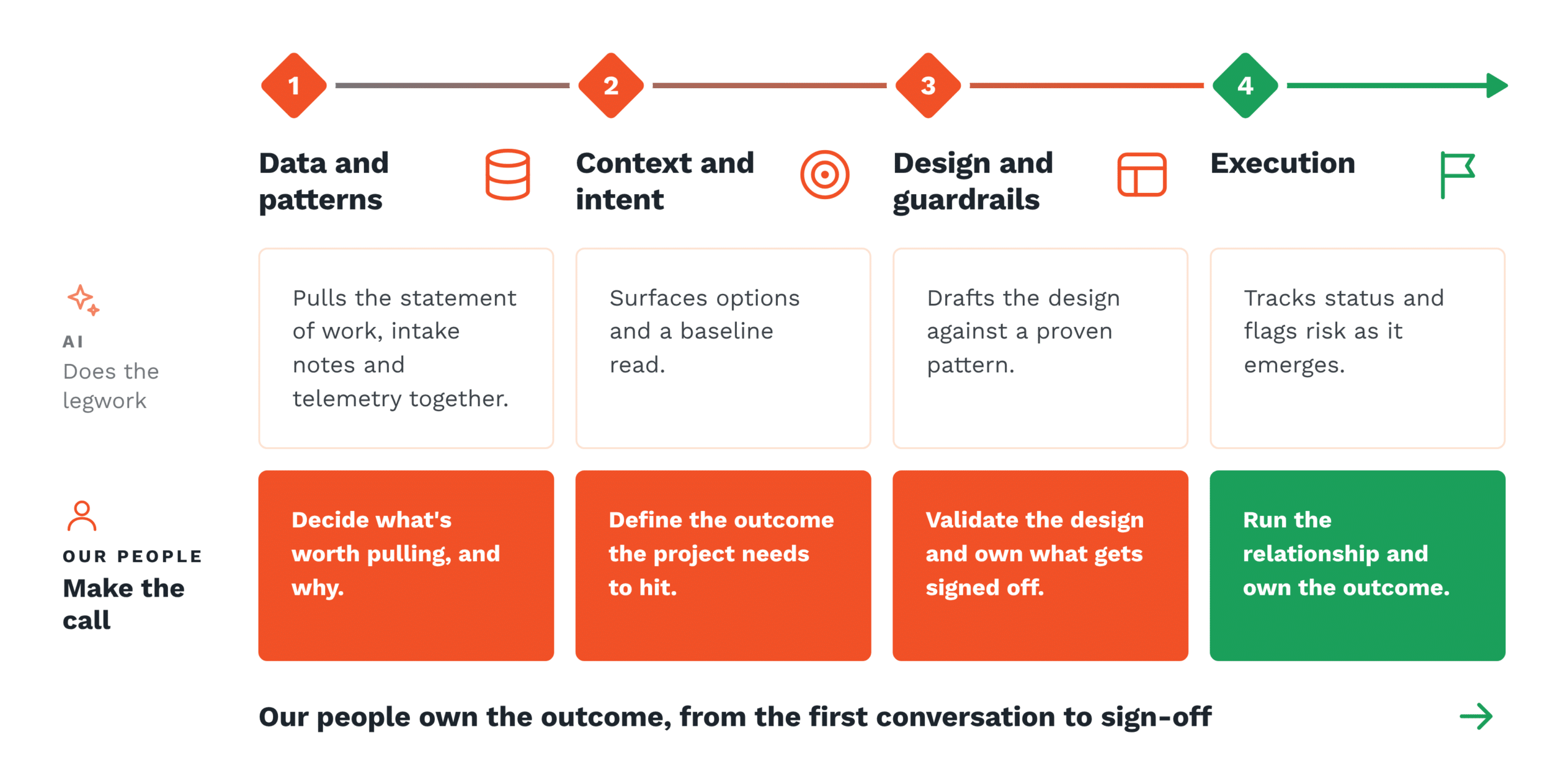
AI speeds up the path from where an environment is today to where it needs to be. It does not decide what “done” looks like, and it does not carry the accountability when something goes wrong. We apply that principle from the first client conversation through to sign-off, and it doesn’t change with the technology, the role or how much of the drafting AI has taken on.
The expensive part of a project was never the drafting
We sort the work in a project into four tiers, based on how much it matters to the business and how complex it is to get right.
- Tier 1 is automated baselines. Drafts, scans and status reports sit here, and clients should not be paying hourly rates for administrative drag.
- Tier 2 is AI-augmented delivery, such as architecture blueprinting, critical-path forecasting and log synthesis. AI makes this work faster and more precise, with a person steering it.
- Tier 3 is human judgement and context. Stakeholder alignment, organisational change and scope negotiation all involve friction that only a person can work through.
- Tier 4 is human-led governance. Security sign-off, architectural trade-offs and compliance accountability need one person accountable for the decision, and AI can’t be that person.
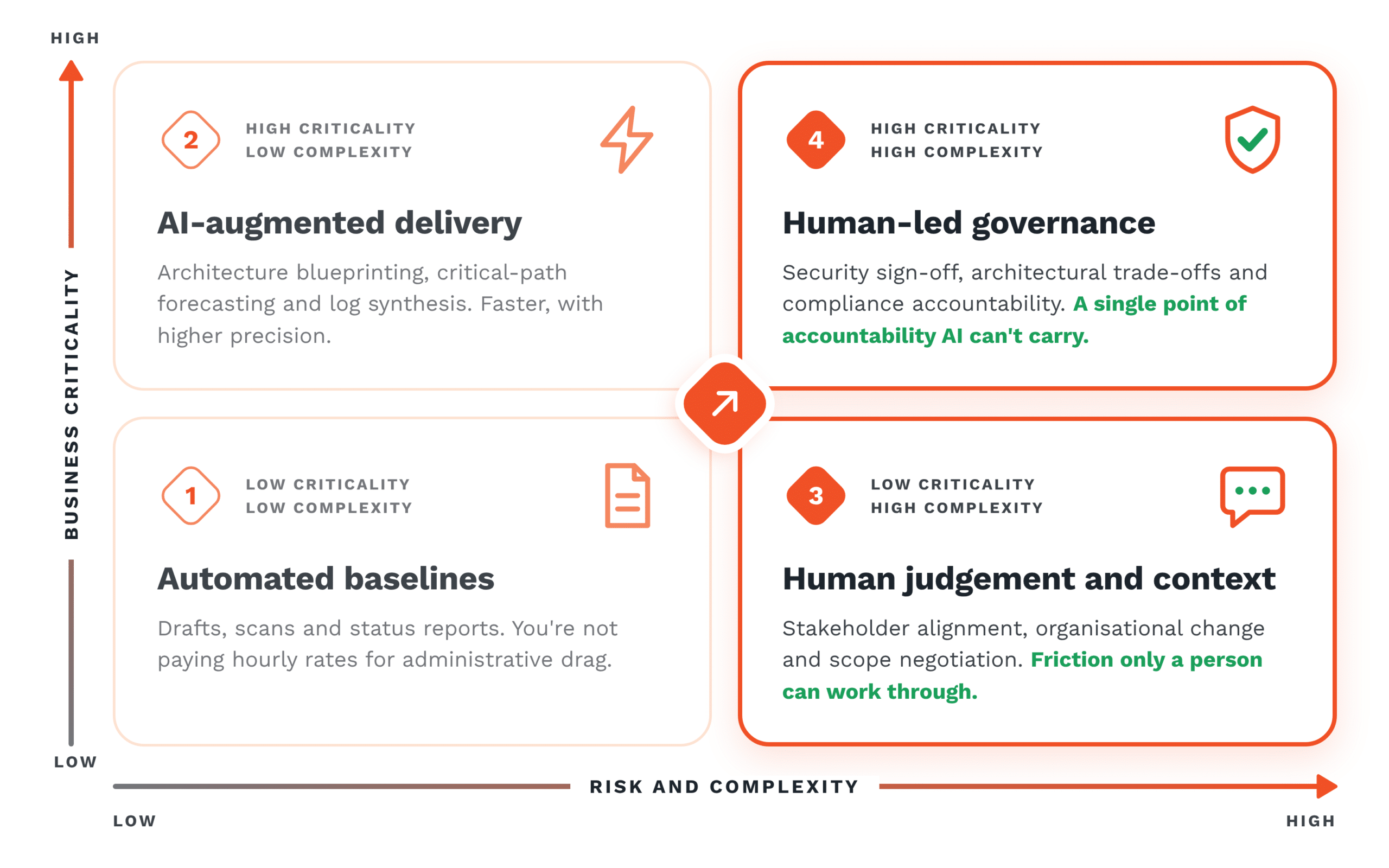
Less of a project sits in the first two tiers than it looks from the outside. The drafting is the visible part, so it’s easy to assume that’s where the time and cost go. On the projects my team delivers, the effort that decides whether a project lands sits in tiers 3 and 4: getting the right people to agree, deciding what the business can live with, and putting a name against the sign-off.
That makes it worth asking where a project sits before it starts. If the work is low risk and low complexity, most of it falls into tiers 1 and 2, and your own team may be able to run it with the right tools. A project that is critical to the business and complex to get right belongs in tiers 3 and 4, and that’s the work to scope properly with a specialist partner.
AI earns its place by shifting where the senior hours go. Every hour it takes out of tiers 1 and 2 is an hour a senior person can spend on tiers 3 and 4.
The judgement call sits in a different place for each role
The line between what AI absorbs and what a person decides falls into a different place for each role. The examples below show the kind of judgement involved. They aren’t a description of everything each role does.
A project manager can hand status reporting, meeting minutes and forecast movements to AI. That takes the administrative load off their week, and the time goes back into higher-value work, managing risk most of all. They spot problems early, decide what gets escalated and when, and handle the scope-creep conversations with the client before they become disputes.
For an end-user computing architect or engineer, AI can produce the baseline SOE build, the app-compatibility scan and the migration run sheet. The person validates the exceptions against how the business works day to day. They also own whether staff adopt the new environment, which matters as much as the cutover itself.
A cloud architect or engineer can get landing-zone and infrastructure-as-code baselines, cost modelling and governance drafts from AI. They test the trade-offs against the client’s real risk appetite and budget, and confirm the disaster recovery design meets the recovery objective the business needs.
For a network architect or engineer, AI parses telemetry, generates baseline configs and flags anomalies. It can’t see fibre paths, rack and power limits or interference on a particular site. Our people validate the design against those physical constraints and handle the legacy and multi-vendor edge cases that don’t fit a pattern.
In every one of these roles, AI takes hours out of the work. The decision, and the accountability for it, stays with a person who knows the client’s environment.
Raw AI looks right until it meets your environment
By raw AI, I mean output that goes into an environment without anyone checking it against that environment. It looks right, and the cost shows up later.
- Configuration with correct syntax can still break a legacy dependency or a compliance requirement. Our engineers test AI-generated scripts against the client’s actual environment before they run.
- Automated status updates have no read on friction inside the team or competing priorities between stakeholders. Our project managers build consensus, resolve scope friction and hold accountability in the room.
- AI output is confident, and it can still invent dependencies or use outdated syntax. Our people verify AI output and sign it off before it goes into production.
- AI works to the instruction it’s given, and a prompt rarely captures return on investment, staff adoption or the reason the client started the project. Our people keep the work pointed at those.
None of this is an argument for keeping AI out of a project. We use it in our own delivery work, and clients should expect their partner to. The test is what happens to the output afterwards. Someone has to check it against your environment, sign it off and answer for it if it turns out to be wrong. If nobody owns that step, the risk sits with you, however good the output looked.
How Tecala can help
Tecala’s Professional Services team runs the project work behind our consulting, managed services, cloud and communication services. That covers strategic roadmaps, audits and assessments, getting environments ready for managed services, cloud transformation and network builds. Start with our services overview to see the work we do, or use the contact us form on the right to talk to our team.